ADVOCACY
Policies Matter:
Shaping the Future of Art Education
Kari Lynn Schneiderʼs policy assignment advocates for contexts that allow for students to operate as artists.
(View the full policy here.)
Policy and advocacy concepts are introduced to preservice and early-career students through a project-based assignment.
Amanda Galbraith
Preparing educators for today’s rapidly changing landscape requires developing instructional skills, deepening content knowledge, and fostering community, and professionalism. Preservice and early career educators also need an awareness of how laws, policies, and contexts shape education (Baer, 2020) and strategies to influence decisions that impact their students (DeMink-Carthew & Bishop, 2017; Rausch et al., 2024).
This article provides an overview of a project-based assignment designed to introduce policy and advocacy concepts to preservice and early career students in a graduate program.
Course Context
The project was part of a required History and Philosophy of Art Education course. Some students took this early in the program; others took it as their final course. The course met asynchronously for five weeks during the summer and moved quickly through all six learning modules.
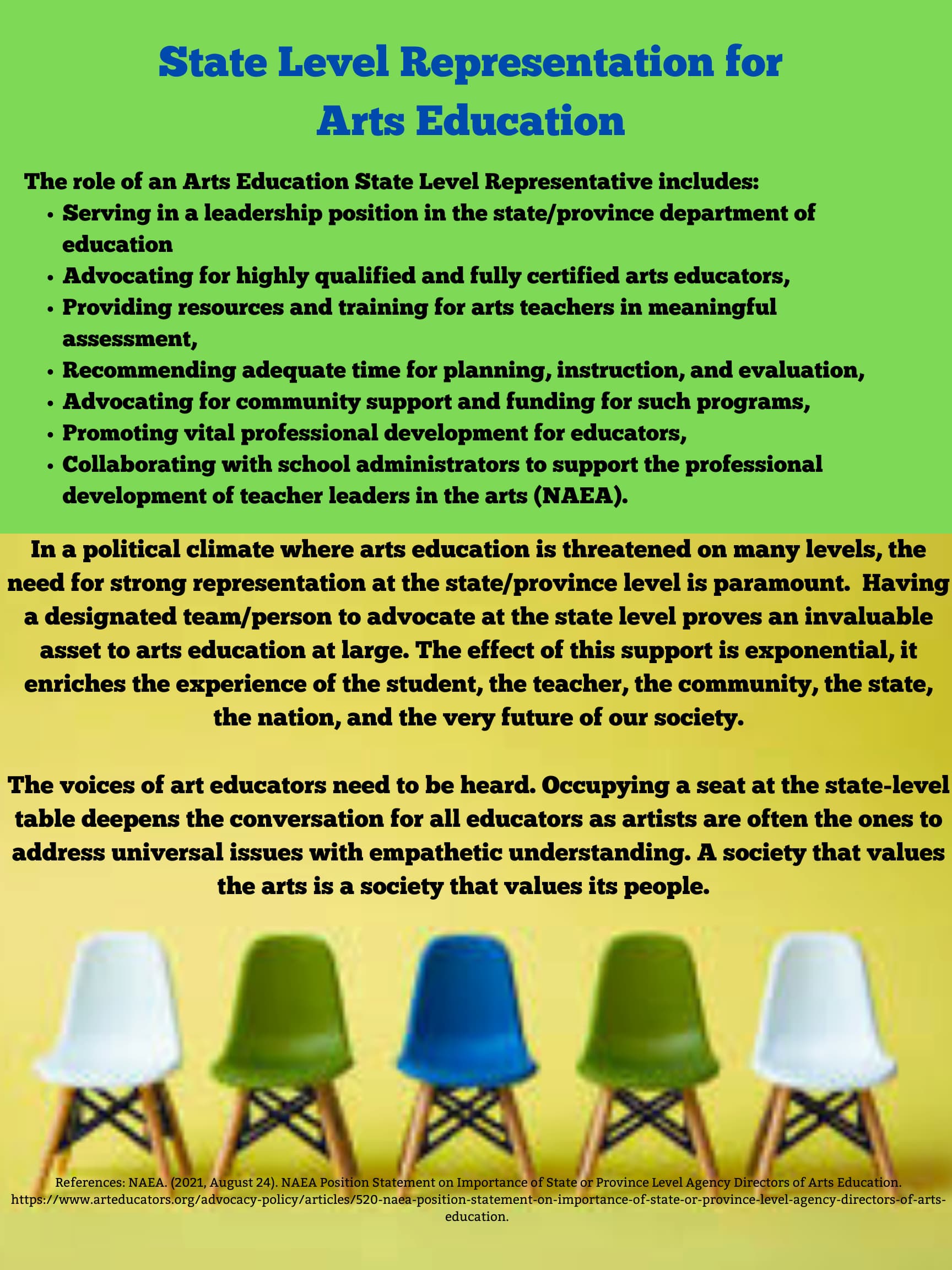
Kristin Rabalaisʼs policy assignment encourages art educators to be involved in leadership and decision-making. (View the full policy here.)
Michael Korfhageʼs policy assignment provides a resource for art educators to crticially consider the uses of artificial intelligence (AI) in art education. (View the full policy here.)
Students analyzed historical and contemporary movements, key figures, events, and theories in US art education from 1860 to the present. They examined the rationale for art education and the impact of history on current practices. Many of the assignments incorporated art-making and opportunities for peer feedback. The policy topic assignment was the fourth of five major assignments.
Project Design
- Students posted their chosen policy topic on the class discussion board, allowing peers to share relevant resources, including town hall recordings, advocacy materials, and position statements from the National Art Education Association (NAEA) and our state affiliate, the Tennessee Art Education Association (TAEA).
- Students prepared a one- or two-page information sheet about the topic and described its relation to art education. These sheets incorporated visuals and text to communicate key ideas.
- Students prepared a two- to three-minute presentation in a chosen format: an individual presentation with visuals, a short interview with a stakeholder who has experience with the topic, or a “see the other side” approach that analyzed potential barriers related to their topic.
- Students reviewed the materials created by the other members of the class and provided feedback in the online discussion forum.
Project Evaluation
The information sheets were assessed for visual organization, clarity of the description of the issue, connection to art education, and correct citation of sources. Presentation evaluation criteria included clarity of the description of the topic, organization of the content, and the relevance of suggestions for sustaining what is working or making progress on the topic. Projects were also assessed on the extent to which the visuals and text provided an interdependent and cohesive portrait of the issue.
Projects that invite students to analyze policy and develop strategies for advocacy empower them with tools to shape the future.
Student Responses
This project has been implemented across three sections of a course, and the responses from students have covered a range of topics. The figure below shows a history of the topics that students selected, grouped by NAEA’s position statement categories. While some categories appeared consistently across all three years, no specific topics repeated every year. In 2022, five students chose curriculum-related topics, including arts integration, STEAM, Every Student Succeeds Act, 4C’s (Creativity, Critical Thinking, Collaboration, and Communication), and state academic standards. In 2025, only one student selected a curriculum topic, while four students focused on instruction-related issues. This variation reflects the diverse interests of the students and underscores the complexity of the field of art education. Seeing the selection of topics over time highlights the importance of preparing early career educators with knowledge of impactful policies and strategies for implementation.
Future Directions
This assignment will likely change in future courses. One modification could involve creating materials for audiences beyond the class, such as parents, administrators, or policymakers. Another option is to expand the resources students review, with careful curation and grouping to match the course timeline.
Although it is difficult to fully envision what is next for art education, projects that invite students to analyze policy and develop strategies for advocacy empower them with tools to shape the future for themselves and their students.
REFERENCES
Baer, S. (2020). The Future Is Ours: Lighting the Fire With Preservice Advocacy Experiences. Art Education (Reston), 73(5), 38–43. doi.org/10.1080/00043125.2020.1766920
DeMink-Carthew, J., & P. A. Bishop (2017). Passion is not enough: Preparing middle level preservice teachers to be advocates for change. Middle School Journal, 48(2), 14–23. doi.org/10.1080/00940771.2017.1272914
Rausch, A., E. Steed, & P. Strain (2024). Development and evaluation of an advocacy course for early childhood special educators. International Journal of Inclusive Education, 28(10), 1983–1998. doi.org/10.1080/13603116.2022.2046190
Amanda Galbraith is a postdoctoral research associate at the University of Tennessee, Knoxville. amandaegalbraith@gmail.com